Mercedes-Benz EQS 2026: the saloon that beats its own official rating
The 2026 EQS beat its own official range rating on the motorway in an independent test. But two very different cars share this model year, and the figures doing the rounds do not always refer to the same vehicle. Our analysis, backed by verified facts.
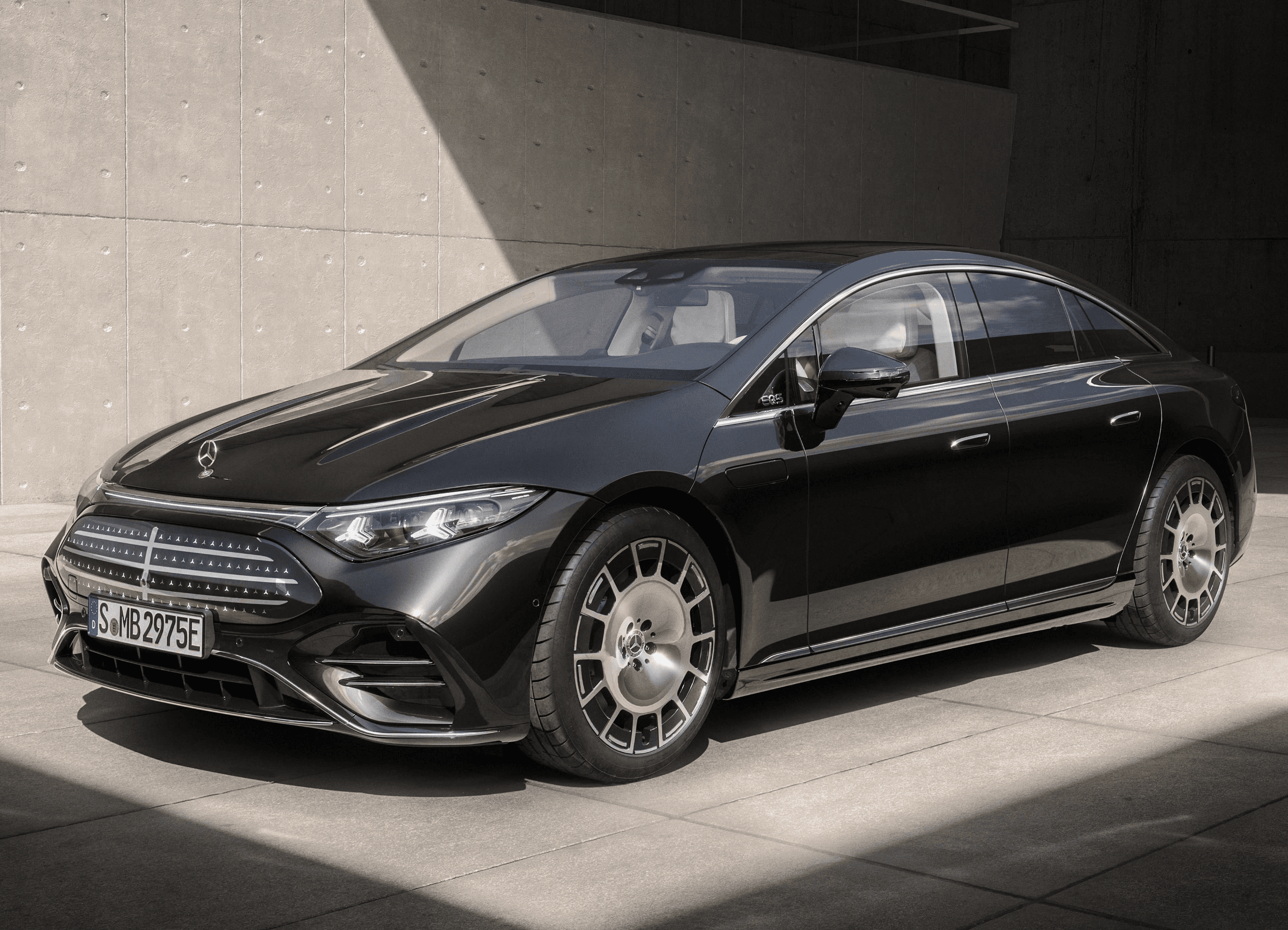
An electric saloon capable of beating its own official range rating on the motorway is not something you see every day. Yet that is exactly what makes the 2026 Mercedes-Benz EQS as fascinating as it is hard to sum up in a single line.
Here is what you need to understand before signing: behind the "EQS 2026" label there are in fact two very different cars, and the figures doing the rounds do not all refer to the same vehicle.
the context: two EQS models share the same model year
On one side, a carry-over 2026 EQS, technically unchanged, built on a 400-volt architecture: this is the one tested by the American specialist press, notably Car and Driver and Consumer Reports. On the other, a thoroughly revised EQS has been announced, with an 800-volt architecture, a 122 kWh battery and a claimed WLTP range of 926 km.
Both exist under the 2026 badge, and mixing them up produces a spec sheet that matches no real car. In this article, we systematically separate the measured car, backed by independent test figures, from the announced car, whose data comes from a single unofficial source.
This is not excessive caution. For a subscription, what matters is not a press release promise, it is what the car does on Monday morning on the motorway, with a half-full battery, at ten degrees.
what is the real-world range of the 2026 EQS?
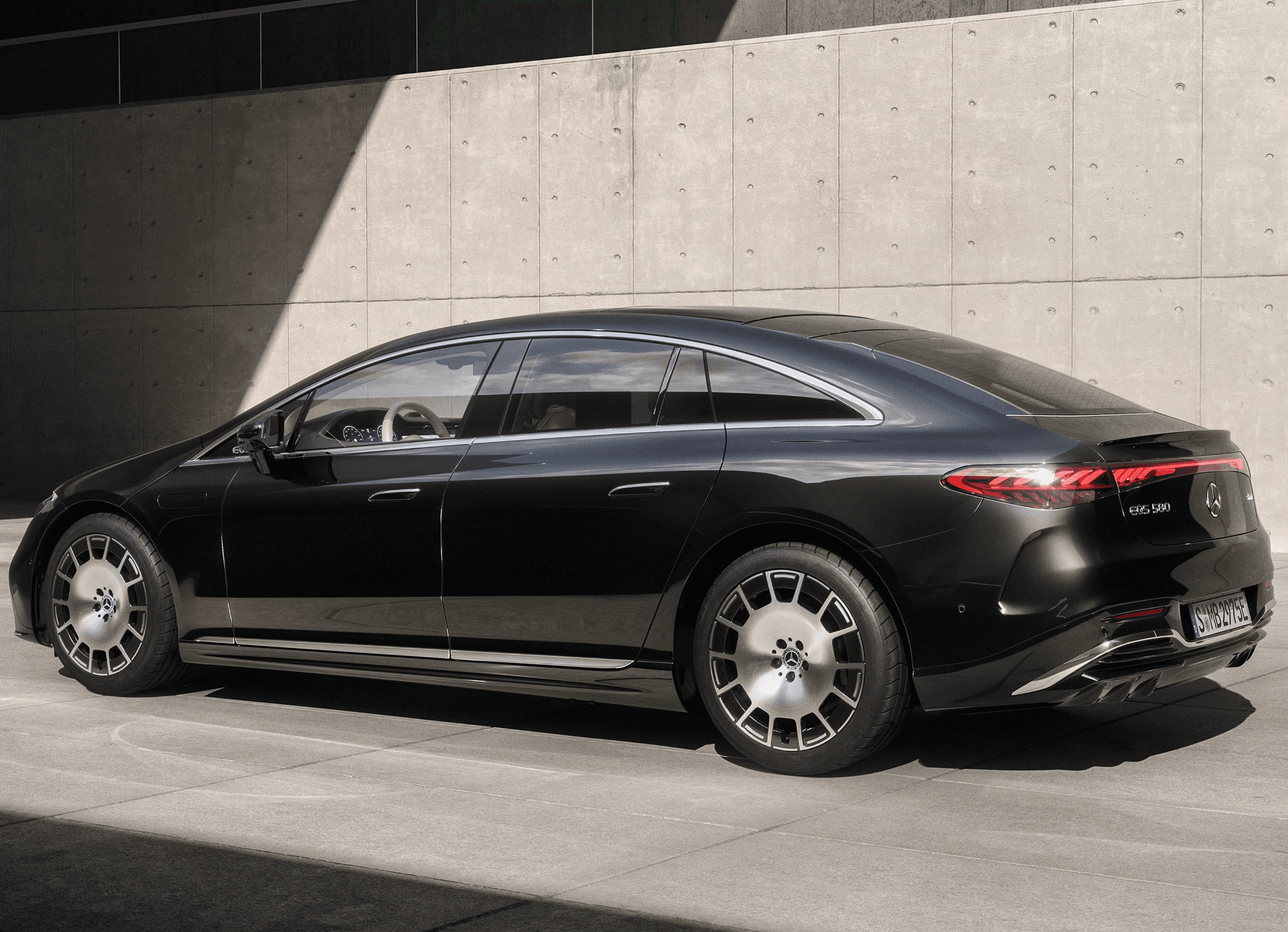
Let us start with the measured version. The battery has grown to 118 kWh, and the EQS 450+ posts an EPA-estimated range of 350 miles, roughly 563 km on the American cycle, which is notoriously stricter than the European WLTP.
The figure that deserves attention comes from Consumer Reports. In its motorway range test at 70 mph (about 113 km/h), the organisation measured 380 miles, close to 612 km, with an EQS 580 4Matic. In other words, a more powerful all-wheel-drive version exceeded the rating of the most frugal variant, at sustained speed. In the electric world, that is the exception: most models lose range as soon as the motorway begins.
One point to watch: earlier EQS models used a 108 kWh pack. Before comparing two tests, check which battery the car under review was fitted with. In Europe the picture is broader: on the UK market, Carwow quotes a range of 377 to 481 miles depending on the version, efficiency of 3.3 to 3.6 miles per kWh and batteries from 96 to 118 kWh.
- Battery in the tested version: 118 kWh (versus 108 kWh on earlier models).
- EQS 450+: 350 miles of EPA-estimated range.
- EQS 580 4Matic: 380 miles measured by Consumer Reports at 70 mph.
- European line-up (source Carwow, UK market): 96 to 118 kWh, 377 to 481 miles, 3.3 to 3.6 miles per kWh.
how much power, and what does it feel like?
On the measured car, the range structure is easy to read. The rear-wheel-drive EQS 450+ uses a single rear motor producing 329 horsepower. The EQS 580 4Matic steps up to 516 horsepower thanks to one motor per axle, and therefore becomes all-wheel drive.
One caveat: Carwow's UK listing mentions outputs of 292 to 360 hp, which does not match the American values. Range structures differ between markets, and it is worth checking the exact version offered locally rather than transposing a figure from one continent to another.
On the 0 to 100 km/h sprint, let us be honest: we have no verified figure. Consumer Reports describes the acceleration as "tantalizingly quick", which is qualitative, not a stopwatch reading. Rather than quoting an approximate number, we prefer to say the data is missing. A subscription should be decided on facts, not on estimates dressed up as certainties.
does the charging match the positioning?
This is probably the most uneven chapter of the case. On the current version, maximum charging power sits between 170 and 200 kW, with a quoted DC charging time of 31 to 32 minutes, and AC charging of 13 to 17 hours. The charging flap is on the right rear.
An important clarification: the 31 to 32 minute figure is not explicitly presented as a 10-80 %. We will therefore not publish it under that label. On a 240-volt domestic socket, expect around 12.5 hours from a near-empty state, which puts the EQS in the category of cars you charge overnight, at home or at the office.
This is precisely where the revised version changes things, if confirmed. The 800-volt architecture would allow DC charging at 350 kW, with 320 km recovered in ten minutes. Watch the format of that data: it refers to kilometres added in ten minutes, not a 10-80 % time. The two metrics cannot be converted into one another.
what exactly does the revised version promise?
A methodological reminder: all the data in this section comes from a single source, a specialist blog, and not from an official Mercedes-Benz press release. It should be treated as unconfirmed.
- EQS 450+ announced at 926 km of WLTP range, a 13 % improvement.
- 122 kWh battery, with an updated silicon-oxide-graphite cell chemistry.
- 800-volt architecture allowing 350 kW on DC, and 320 km recovered in ten minutes.
- New two-speed rear transmission, designed for motorway efficiency.
- First German production vehicle to offer steer-by-wire.
- MB.OS replaces the entire infotainment and vehicle management architecture.
- More than a quarter of the components updated; the move from 400 to 800 volts draws on the architecture of the latest CLA.
If these elements are confirmed, this is not a facelift but a technical overhaul. The switch to 800 volts, in particular, addresses the current EQS's main weakness against its rivals: fast charging that is decent, but far from exceptional at this price level.
do the cabin and controls live up to the promise?
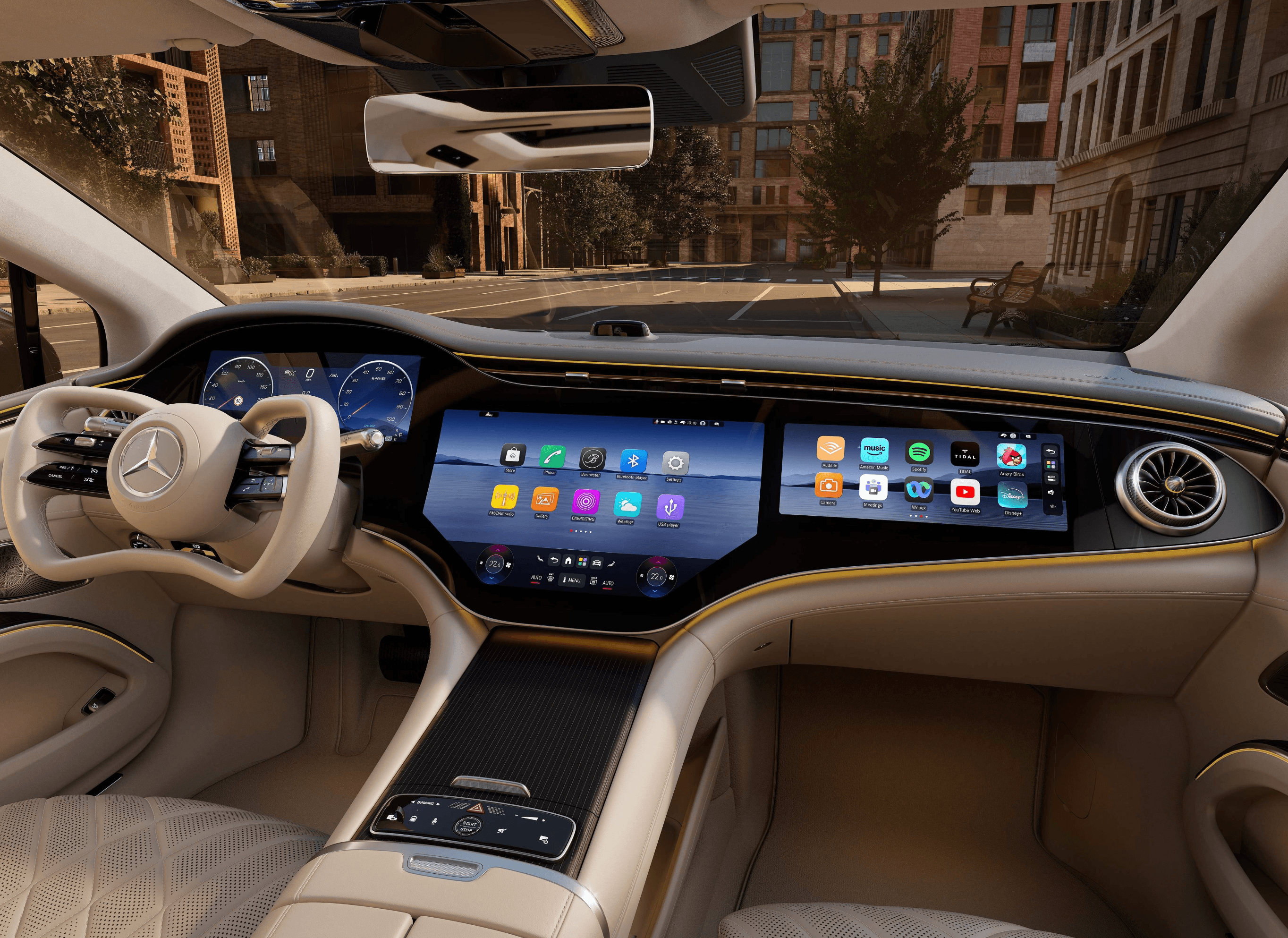
The Hyperscreen remains the car's signature: three displays brought together behind a single continuous glass panel spanning the whole dashboard. The effect is striking at a standstill. On the move, Carwow calls it "a bit distracting", and that verdict is not an isolated one.
This is the EQS's recurring friction point. The same testers who praise its comfort, its silence and its road manners mention highly distracting controls and an odd brake feel, two criticisms that led them to wonder whether they would want to live with the car day to day. On a saloon of this standing, that is exactly the sort of thing that wears thin after six months.
For the rest, the equipment is up to standard: a broad suite of advanced driver assistance systems, and a 620-litre boot, remarkable for a hatchback saloon in this category.
- Hyperscreen: three displays under a single sheet of glass.
- Advanced driver assistance systems in generous standard fit.
- 620-litre boot.
- Friction points flagged by the press: distracting controls, unusual brake feel.
how does it stack up against its rivals?
Here we have to set a limit rather than a table. The EQS's two natural rivals are the BMW i7 and the Lucid Air, with the Porsche Taycan as a sportier alternative. At this stage, we do not have verified and consistent sets of specifications for these models in the relevant model year.
Yet a comparison is only worth something if the data blocks are comparable: same model year, same homologation cycle, same charging measurement method. Lining up a WLTP range on one side and an EPA estimate on the other, or a 10-80 % time against kilometres recovered in ten minutes, produces a false ranking. We would rather show a visible gap than a manufactured comparison.
What can be said with certainty: the EQS stands out less for outright performance than for ride comfort, silence and motorway efficiency documented by an independent test. This is the profile of a long-distance cruiser, not a sports saloon, and that is the ground on which it should be judged once rival data becomes available.
At Turismo, this is also a reason to favour subscription: it lets you try a category of car over several months, without tying up capital in a segment where technical architectures change from one year to the next.
how much does it cost, and does a subscription make sense?
One concrete and telling benchmark: the EQS 580 bought by Consumer Reports for its testing was the most expensive vehicle the organisation has ever purchased, with an as-tested price close to 136,000 dollars. That is the segment's entry ticket.
We do not have a verified base price for European markets, nor a confirmed subscription monthly rate for this model, and we will not invent them. What we can explain, however, is the economic logic.
- The residual value risk on an electric saloon costing more than 100,000 euros is carried by the subscription, not by you.
- The announced move from 400 to 800 volts creates a technical break: a long commitment to the current generation exposes you to rapid obsolescence on charging.
- Insurance, servicing and maintenance are included in the monthly payment, which makes the cost of use clear from month one.
- Flexibility lets you test subjective points day to day, such as the Hyperscreen or the brake feel, which three thirty-minute test drives never reveal.
To discover the Turismo plans available in Luxembourg, Belgium, France and Switzerland, browse our catalogue of all-inclusive premium subscriptions.
the verdict
In its measured version, the 2026 EQS is an electric long-distance cruiser of rare calibre. The 380 miles recorded at 113 km/h by Consumer Reports on the EQS 580 4Matic, above even the EPA rating of the 450+, is the strongest argument in the case.
The reservations are just as clear. Controls judged distracting, an unusual brake feel and fast charging capped between 170 and 200 kW leave it short of what you expect from a car listed at close to 136,000 dollars in test configuration.
Verdict: one to lease or take on subscription rather than buy, at least until the 800-volt version is officially confirmed. If the 926 km WLTP, the 350 kW and MB.OS all prove true, the revision will not be a simple facelift but a change of generation. Committing today to the 400-volt version for several years would then be a poor calculation. A subscription, by contrast, leaves the door open.
faq
What is the real-world range of the 2026 Mercedes EQS?
On the current version, the EQS 450+ is credited with 350 EPA-estimated miles. Consumer Reports measured 380 miles at 70 mph with an EQS 580 4Matic, a result above the official rating. On the UK market, Carwow quotes a range of 377 to 481 miles depending on the version.
How long does it take to charge a 2026 EQS?
On DC, charging is quoted at between 31 and 32 minutes, with a maximum power of 170 to 200 kW. Note: this duration is not explicitly described as a 10-80 %. On AC, expect 13 to 17 hours, and around 12.5 hours on a 240-volt socket from a near-empty state.
How powerful is the 2026 EQS?
The rear-wheel-drive EQS 450+ produces 329 horsepower with a single rear motor. The EQS 580 4Matic rises to 516 horsepower with one motor per axle. On the UK market, Carwow lists values of 292 to 360 hp, reflecting a different range structure from market to market.
What is the 0 to 100 km/h time of the 2026 EQS?
We have no verified figure. Consumer Reports describes the acceleration as "tantalizingly quick", without publishing a stopwatch time. We prefer to flag the missing data rather than offer an estimate.
What is the difference between the 2026 EQS and the revised version?
The current version is based on a 400-volt architecture with a 118 kWh battery. The announced revised version moves to 800 volts, with a 122 kWh battery, 926 km WLTP, 350 kW charging and the MB.OS system. These figures come from a single unofficial source and still require confirmation from Mercedes-Benz.
in summary
In its measured version, the 2026 EQS is an electric saloon with exceptional motorway efficiency, documented at 380 miles at 113 km/h, but held back by contested ergonomics and fast charging capped at 200 kW. A thoroughly revised 800-volt version has been announced but not officially confirmed.
In this context of technical transition, subscription is the most rational answer: it gives you access to the car without carrying the residual value risk or the risk of a generational leap. Insurance, servicing and maintenance included, a single monthly payment, and the freedom to switch when the 800-volt version really arrives.
Discover the premium electric saloons available on Turismo subscription in Luxembourg, Belgium, France and Switzerland, and speak to an advisor to define the plan that matches your real mileage.
Sources(12)
- 2026 Mercedes-Benz EQS Road Test Report - Consumer Reports
- Mercedes-Benz EQS Review 2026 | Range, Interior & Price | Carwow
- 2026 Mercedes EQS Revealed: 926 km Range, 800V, Steer-by-Wire
- Mercedes-Benz G-Class EV
- Mercedes-Benz GLC with EQ technology
- Mercedes-Benz EQS
- 2026 Mercedes-Benz EQS Prices, Reviews, and Pictures | Edmunds
- New Mercedes EQS 2026 Review: Price, Specs, Range & On Sale Date | Electrifying
- Mercedes-Benz EQB
- 2026 Mercedes-Benz EQS 450+ Prices, Reviews, and Pictures | Edmunds
- 2026 Mercedes-Benz EQS 450 4MATIC Prices, Reviews, and Pictures | Edmunds
- 2026 Mercedes-Benz EQS Sedan Review, Pricing, & Pictures | U.S. News